
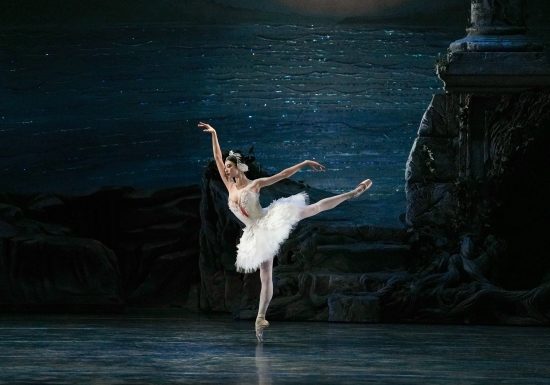
Chloe Misseldine as Odette in Swan Lake. Photo: Emma Zordan.
Since Susan Jaffe took the reins at American Ballet Theatre at the end of 2022, people have been wondering what direction the company would take under her leadership. It was not an easy time to step into this position. The company, like all of the performing arts, was just emerging from the stasis of the pandemic, and there were rumors that it was short of funds. A few months later, the company lost its choreographer in residence, Alexei Ratmansky, to New York City Ballet. Around the same time, its executive director, too, departed.
Out of necessity perhaps, Jaffe kept things simple, often dipping into the existing repertory, much of it from the period when she was a dancer at the company in the eighties and nineties. (She rose up to become a star during Baryshnikov’s tenure, 1980–1989.) Of the new works Jaffe brought to the stage, two had premiered elsewhere: Wayne McGregor’s Woolf Works and Christopher Wheeldon’s Like Water for Chocolate. Neither appears to be a lasting addition to the repertoire. The first original evening-length ballet Jaffe commissioned, Helen Pickett’s Crime and Punishment, was a dud: tiresomely didactic, dance-thin. It quickly disappeared.
So, newness has not been a Jaffe forte so far. Instead, the company has tended to look back. In 2024 Jaffe revived the “Shades” scene from Natalia Makarova’s production of La Bayadère, a ballet that was once the pride of ABT but now looks as if it would benefit from a thorough rethink. When Makarova’s Bayadère premiered at ABT in 1980, it was seen as proof that the company had achieved a new level of classical polish. Now the full version La Bayadère, set in an exotic, fantastical “ancient India,” has been pushed aside because of its orientalist aesthetic and plot. By that logic, a good portion of the nineteenth-century repertory has been consigned to the closet. The only section of La Bayadère that can comfortably be performed on American stages is the ballet blanc from Act III, in which a long line of women in white tutus descends a slope down to the stage, performing a series of perfectly synchronized movements, as if moved by a single brain. These figures are meant to represent spirits (or “shades”) and thus cannot offend anyone.
ABT’s recent performances of the “Shades” scene projected a quality that has become more pronounced since 2022: an amorphous, generically “classical” style characterized in part by a vague musicality. What does “vague musicality” mean? Dancing that is more or less on the music but that doesn’t respond vividly to the music; dancing that fails to elicit that little explosion of pleasure that happens when movement and sound come together at the exact same moment, becoming two different manifestations of the same intention.
This general lack of musical symbiosis has been most noticeable in Jaffe’s stagings of canonic classical works like the “Grand Pas Hongrois” (i.e., suite of dances) from Petipa’s Raymonda and her new/old Don Quixote. Jaffe’s rendition of the Grand Pas from Raymonda appeared not long after Alexei Ratmansky staged another, similar suite from Petipa’s Paquita at New York City Ballet. In that revival, everything glistened and popped. In Jaffe’s staging of Raymonda, the dancers floated through the ballet’s exquisitely difficult variations with technical aplomb but little incisiveness. The tempi were slow, phrasing was loose. The impression it left was of something faded, not terribly exciting, and with no discernible point of view.
Jaffe’s new Don Quixote, staged in collaboration with the company’s régisseur Susan Jones, premiered this past June at the Metropolitan Opera House. It had similar problems. It should be said, before going into detail, that Don Q, as this ballet is known in the biz, is a completely silly ballet that has been tampered with again and again since its premiere in Moscow in 1869, with choreography by Marius Petipa. Dances have been added, dances have been subtracted; the mime has changed many times over; many, many jokes have been interpolated. To be clear, the ballet bears almost no relation to Cervantes’ novel. But it has three virtues: an energetic, Spanish-inflected score by Ludwig Minkus; exciting bravura dancing for the main characters and a few of the secondary ones; and at its best, an infectious sense of fun.
Jaffe set out to refresh the company’s production, which dates from 1995. The sets and costumes were left unchanged—as Jaffe said in a preview article in the New York Times, there was no money for new ones. Still she had felt the need to go through the ballet scene by scene, editing and reviewing details. A new male dance with tambourines was added in the first act; a dreamily Romantic pas de deux was slipped in at the start of Act II. (Forget that the pas de deux was choreographed in a style completely at odds with anything else in the ballet, which is already a stylistic hodgepodge.) A stodgy but virtuosic male solo, known as the “Cup Dance,” that Mikhail Baryshnikov used to dance, was restored in Act II. The crowd scenes were cleaned up—Jaffe told the Times that she found these scenes overly chaotic.
Unfortunately the result is a production lacking a specific style, whose tone changes from scene to scene. Worse yet, the ballet has been drained of its best quality: energy, fun, zest. The chaotic crowd scenes, a leftover from the ballet’s twentieth-century evolution at the Bolshoi, have become polite gatherings in which the dancers clap in time and take turns displaying their choreographic “bits.” The mime, already broad, has become even broader and more emphatic. Gamache, a ridiculous aristocrat who hopes to marry the fiery heroine Kitri, is portrayed with even greater exaggeration than before, and is even less funny. A scene in which the male lead (Basilio) fakes his own death and uses this tragic ruse to cop a feel of his sweetheart’s breasts has become both more vulgar and less funny. Everyone seems to be going through the motions.
The scene that has survived the best, paradoxically, is the least theatrical: the abstract classical ballet that occurs in Don Quixote’s dream after he is knocked out in his battle with the windmills. It is a proper Petipa dream sequence, with a large corps de ballet of female dancers in tutus creating intricate geometries around three ballerinas who perform the gamut of academic steps. (For those who are wondering: No, this interpolation of high classical ballet makes no sense in the context of the story.) Weirdly, in Jaffe’s staging, this scene becomes one of the ballet’s high points. I suppose that its classicism can be credited for this. When something is beautifully crafted and based on an extremely refined vocabulary, it withstands the passage of time. It was here that the ballerinas playing Kitri in various casts appeared to be most in their element, perhaps because they knew exactly what was expected of them. This was true of both Catherine Hurlin and SunMi Park, as well as of Sierra Armstrong in the supporting role of Dryad Queen (don’t ask), and of two quick-footed, high-flying cupids, Zimmi Coker and Léa Fleytoux. And yet even here, the musicality was merely correct, at best.
When the dream sequence in Don Q becomes the ballet’s high point, you know you are in trouble. Elsewhere, Hurlin, normally a wonderful comedienne as well as explosive technician, seemed to be mugging with all her might as if in an effort to pour some life into the stage action. Her partner, Isaac Hernández, in contrast, appeared to hold back in an effort to avoid pushing beyond his technical comfort zone. Tall and handsome, he is nevertheless a cipher onstage. What does he think about when he dances? It’s hard to tell. Despite his considerable abilities, he fell out of one of his jumping turns (a double-tour), to his own apparent shock. Perhaps he was having a bad night. What this ballet needs, though, is not a better cast, but a complete reimagining by a choreographer who can imbue it with a coherent tone and style.
The rest of ABT’s spring season at the Met consisted of: John Cranko’s Onegin, inspired by the Pushkin poem; Frederick Ashton’s delightful nod to late nineteenth-century French mythological ballets, Sylvia; and the company’s stalwart production of Swan Lake, still going after 26 years. With the exception of Sylvia, this was an especially stodgy assemblage of ballets, even for ABT, not known for its adventurousness. But, as Jaffe said in the Times interview, “there’s only that many great works in the ballet canon that are full-length ballets and that are classical.” That’s true up to a point. But ABT’s repertory contains many more full-length ballets than these, including at least two masterpieces by Frederick Ashton, La Fille mal gardée and Cinderella. Not to mention several full-length ballets made for the company by its previous choreographer in residence, Alexei Ratmansky. (Luckily the company will bring back his Sleeping Beauty next year.) The elephant in the room is that there are several other nineteenth-century ballets that could also be staged—La Bayadère, Le Corsaire, Paquita, Raymonda, and more—if the company were willing to face the problem of exoticism head on, and commission new versions that can be performed in 2026. It is a problem that will have to be faced sooner or later, with intelligence, imagination, and taste. If not, the repertory will become even more stagnant than it already is.
The issue is a burning one, because another feature of the Jaffe era at ABT is the company’s abundance of exceptional, young, up-and-coming dancers. At the end of the season, three more were promoted to the top rank of “principal dancer”: Jake Roxander, SunMi Park and Jarod Curley. They, and others, have been chomping at the bit, ready to take on the full range of roles. Jaffe has adopted the habit of announcing these promotions onstage after performances, turning them into an event. The audience is excited to witness this emotional moment in their careers; the dancers are visibly moved. Six more company members, all excellent, were promoted to soloist (the rank below principal). They are the future of the company, but they will need to be challenged and fed, not with the same old ballets, but with new ones, and with intelligent stagings that require subtlety, care, detailed work.
I’ve mentioned Catherine Hurlin. She is one of ABT’s most exciting, dynamic ballerinas, a real spitfire with a natural acting ability. Her dancing, to my eye, is beginning to develop a slightly bored quality—ergo the overacting in Don Q. What a contrast to see videos of her dancing at the Vail Dance Festival last summer, where she looked newly energized in ballets by Balanchine and Ratmansky, hair and legs flying! (In those videos her nickname, “Hurricane,” felt truly apt.) Another of the company’s young talents is Chloe Misseldine. This past season, she returned to Swan Lake, in which she débuted two years ago. This time she performed with Daniel Camargo, a dancer of uncommon poetry and partnering ability. (Her first partner was Aran Bell.) Misseldine’s début in 2024 was extraordinary in every way: fresh, musical, quietly intense, filled with strikingly beautiful shapes. It was as if Misseldine had been born to dance the role of Odette—as if the role’s contours had lain within her waiting to be revealed. Two years on, her interpretation has evolved, as one might expect. The way she uses her long, long, long-limbed body, and the beautiful shapes she creates with it—and the way she uses her face, almost like a mask onto which she can project the emotions in the music—are still an amazement. In this performance I was particularly moved by the deep curve in her back, suggesting emotion, abandon, openness. At the same time she has an innate sense of taste. She doesn’t overdo things or indulge in mannerisms.
This year, at the Met, her arms were freer, which gave her dancing a slightly wild look, particularly in her entrance at the lakeside. At times she paused en pointe, hovering for a moment longer than seemed possible. Many dancers do this, and it often looks like a show-off move meant to draw applause. Misseldine did it with naturalness and ease, as if introducing a breath between phrases or even in the middle of a phrase. It made her dancing look slightly magical. Camargo, an experienced partner, lingered nearby, ready to offer a hand or a finger when needed. He gave the impression of being as filled with wonderment at Misseldine’s ability to float as the audience was. This ability to sense a ballerina’s flow and allow it to take its course is a skill, and Camargo has it. There was, in their connection, a feeling of trust and care that was almost sensual.
Misseldine is also deeply musical, in a way that makes it appear as if the music were coursing through her limbs, or even as if the music emerged from within her. In the famous lakeside pas de deux, her leg unfurled, moved by the violin, so that her foot arrived to its highest point at the very end of an upward-moving scale, extending the notes into space like a beam of light. It is a thrilling thing to behold, and one that doesn’t happen often enough at ABT these days.
Then, in the “Black Swan” scene, in which the ballerina becomes a scheming double of the swan queen, Misseldine danced with ingratiating assuredness—again, without forcing things. She made the turns, either in attitude, with one leg curved behind her, or with one leg extended to the side, look impossibly easy, which is, let’s just say, extremely rare. Unfortunately the scene was marred by slow tempi. The dancing here should have more attack and more sense of risk. Misseldine would benefit from a coach who can help her develop more variety and fire in her interpretation. For all the beautiful dancing by both Misseldine and Camargo, the scene lacked excitement. In many ways, Misseldine’s Swan Lake today is more impressive than it was at her début two years ago, but also more detached, less emotionally involving.
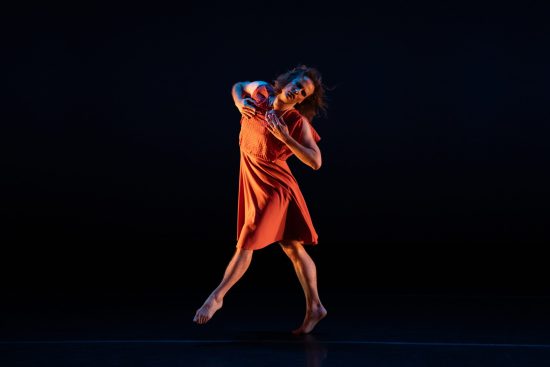
“Say It’s Not You,” a section of Deck of Cards. Photo credit: Julieta Cervantes.
The Mark Morris Dance Group held a two-week season at The Joyce, with three programs of dances set to American music. Morris’ eclectic musical tastes are well known; he has often dipped into Americana over the course of his long dancemaking career. Popular songs, The Violent Femmes, country and western, the Modernist works of West Coast composers like Lou Harrison and Henry Cowell—all have received the Mark Morris treatment. One genre he has tapped into less frequently is jazz. There is of course his solo Three Preludes, set to Gershwin’s Three Preludes for Piano. Morris first danced them, in a wonderful Art Deco style, in 1992. The preludes were included on Program One at The Joyce, which was devoted to popular and pop-classical music by American composers. That program also included a piece set to music by James P. Johnson, a virtuoso of the keyboard who extended ragtime into a style called stride piano, more rhythmically complex, freer. (Johnson composed “The Charleston,” i.e., the musical backdrop to the essential dance of the 1920s.) “You’ve Got to Be Modernistic,” as Mark Morris’ dance is titled, is one of his concept pieces, very intelligently made, very responsive to the music, funny at times, but a little arid.
Of course, no one can move like Morris himself once did. His dancing contained a completely unique combination of floppiness and precision, humor and edge, galumphing heaviness paired with delicacy. His choreography reflects all of these qualities, but its connection to Morris’ own physicality has faded as generations of very well trained dancers who never saw Morris dance have cycled through the company’s ranks. What was once eccentric and personal is now almost a codified style: the Mark Morris style. Musically precise, direct, unfussy, rhythmically complex, cleverly structured. He does not allow the same amount of personality to emerge from his dancers as he allowed from himself. (The original ensemble was a group of friends; this is a dance company.) But sometimes a whiff of the original Mark comes through.
The second program, set to country and western music, is a case in point. The songs often told a story, usually sad. Morris is great with words; he has made some of his best dances to songs by Schubert, Baroque cantatas and masses, even an opera by Purcell. He has a special ability to convey the meaning of words without being enslaved to them, even inventing a very personal kind of mime. The program at The Joyce included a dance for a toy truck maneuvered by remote control, “Gear Jammer,” part of his suite Deck of Cards, from 1983. To Jimmy Logsdon’s country song about the life of a trucker who lives on short order dinners, the little truck traces loop de loops around the stage. It is strangely sad.
The heart of this program was a solo Morris originally made for himself, also from Deck of Cards: “Say It’s Not You,” set to a recording by George Jones. It is choreographed for a man dressed as a woman, in a knee-length dress, pearls, and pumps that the dancer removes at the beginning. The dancer (here, Billy Smith) wears makeup and his long hair down. The words of the song are written from the point of view of a man who has heard rumors that his sweetheart has been “spreading her love around.” “Say it’s not you,” he pleads. The dancer embodies the woman about whom he sings. She’s no floozy, though. Vulnerable, hurt, sad, the woman looks like her heart has been broken many times over. She dances with her palms out, hair in her face, cheek in hand, totally alone. And yet, she also moves with the abandon and freedom of Isadora Duncan, if Duncan had been a man in drag. It’s a wonderful, strange dance, almost tragic. Morris clearly understood this woman. It is almost as if a little piece of her had lived inside of him. Billy Smith channeled that feeling, touchingly so. At his best, Morris is not only a clever and musically sophisticated choreographer, but also a maker of dances that touch on something a little homely, a little lost, a little tragic, in all of us.