
I’ve been struck recently by how context colors art, whether we are seeing something for the first time or returning to a work we thought we knew through and through but that suddenly reveals new colors and sensations. The work is fixed in our mind, until, under the influence of factors beyond its frame, our perception of it changes. I felt this happen time and again this last winter and early spring. Watching dance in a period of extreme turmoil—like the one we are living in today—kept bringing out new resonances, meanings, emotions.
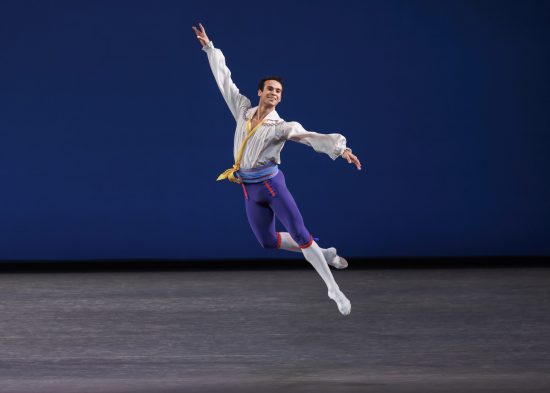
Ryan Tomash in August Bournonville’s Flower Festival in Genzano Pas de Deux. Photo credit: Erin Baiano.
Dance is particularly sensitive to such shifts, because it depicts human behavior without pinning down its meaning with words. The meaning of a jump arcing across the stage or of a proffered hand is left up to the viewer, as he or she sits in the darkened theater. I was particularly aware of this as I watched the pas de deux from August Bournonville’s Flower Festival in Genzano danced by New York City Ballet in January. This excerpt from Bournonville’s 1858 ballet, set in Italy, isn’t part of New York City Ballet’s regular repertory. It was programmed as filler on an otherwise shortish program. Bournonville is Denmark’s great choreographer of the nineteenth century, a contemporary of Hans Christian Andersen and Kierkegaard. He created a style of ballet we seldom see today, one that sets in motion folk tales and genre scenes populated by everyday folk: fishermen, young people on a stroll, farmers, forest creatures, and the odd witch. It is neither epic, like the Petipa ballets, nor abstract, like much of twentieth-century ballet. And, like any good nineteenth-century man, Bournonville was fascinated by the world beyond the borders of his own tiny country, especially Italy, where he had spent several happy months. For him Italy represented sunshine, Catholicism, and an expressive, extroverted culture that contrasted clamorously with his own.
Accordingly, the pas de deux from his Flower Festival in Genzano depicts two young people who explore their attraction to each other through dance. They walk, flirt, touch shyly, look into each other’s eyes, look away. Each dances for the other. Their dancing isn’t showy, but it has buoyancy and warmth and exudes a kind of relaxed joy. The partners treat each other with tenderness and interest. The pas de deux is the opposite of a virtuoso showpiece, though the choreography is littered with challenges: balances on one toe in which the body changes direction, jumps in which the legs beat in the air with brio, fast and clean footwork, phrases of movement that unspool on a single breath, double air turns to the left and to the right, delicate partnering tricks that require minimum contact and an impression of ease.
What struck me most watching the performances at New York City Ballet in January was the way the characters depicted by the two dancers treated each other: the tenderness, the delight in each other’s presence, the warmth. The dancers I saw were Isabella LaFreniere and Ryan Tomash, both tall, both statuesque. LaFreniere is a dancer with strong technique and, usually, a somewhat fixed expression; what she conveys most of all is competence. Tomash, on loan from the Royal Danish Ballet since last fall, is something altogether different. A dancer who watches, listens, and responds to his partners, and who interprets the steps, always suggesting a situation or story that can be expressed through them. At the same time, he remains himself, or at least a version of himself: affable, relaxed, open, curious.
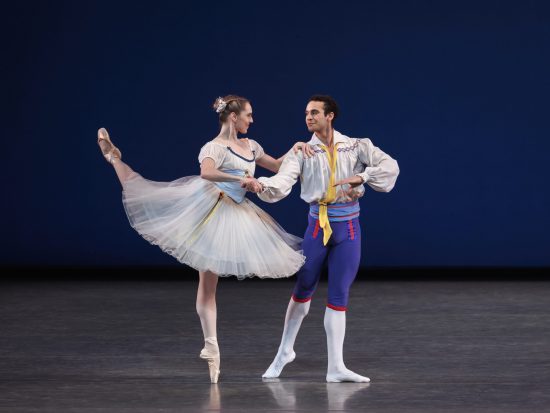
Isabella LaFreniere and Ryan Tomash in August Bournonville’s Flower Festival in Genzano Pas de Deux. Photo credit: Erin Baiano.
As LaFreniere danced, Tomash watched her closely, his hands clasped behind his back, his head tipped slightly to the side, before taking a step and watching her from another angle. LaFreniere seemed to glow in his presence. Her dancing expanded; it was like seeing someone who knows that she is loved. She became vulnerable, unguarded. Then, when LaFreniere stopped for a moment and looked toward Tomash, he launched into his own volleys of steps, leaping on the diagonal, rising and falling on the music, his feet beating together or a leg tracing a small circle in the air as he left the ground. And as he danced, Tomash looked toward LaFreniere, and even curved his upper body toward her, making it clear he was dancing for her, and, through her, for us. The steps, and the manner in which they were performed, were an expression of generosity, of happiness. With this quality, Bournonville stands apart from other ballet choreographers. The art of ballet has many facets: display, presentation, wonder, geometry, virtuosity. Bournonville, uniquely in the repertoire (except perhaps for Frederick Ashton), manages to make it feel deeply human. Good dancers who have familiarity with the style convey this clearly. Tomash has this; LaFreniere is learning. Thus this little pas de deux, a trifle, was elevated to something almost sublime: a model for living. An alternate, better world than our own. New ballets by Justin Peck and Alexei Ratmansky were unveiled during the season as well, but the manner in which the two dancers in the pas de deux from Flower Festival in Genzano treated each other is what stayed with me. Tomash was rightly elevated from soloist to principal dancer at the end of the season. The company is richer for his presence.
American Ballet Theatre held a spring season at the Koch, its first. (The company’s regular yearly season will take place at the Metropolitan Opera House in June and July.) The programs combined Lar Lubovitch’s turbulent full-evening interpretation of Othello, set to music by Elliot Goldenthal, with a new setting of the Grand Pas from Marius Petipa’s Raymonda by the company’s artistic director, Susan Jaffe; George Balanchine’s Mozartiana; Ratmansky’s 2012 Firebird; and a shorter pas de deux by Ratmansky, Neo. I saw everything except Othello. The Raymonda suite was danced blandly, unmusically, with slow tempi and little impact. It lacked a point of view. Mozartiana, one of Balanchine’s final works, and one of his most sophisticated, received a glorious performance by three young dancers in the company: Chloe Misseldine, Michael de la Nuez, and Jake Roxander. At the heart of the ballet is a theme and variations in which the ballerina and her partner take turns in passages of witty footwork, a kind of danced repartée. Misseldine sailed through the choreography with awe-inducing ease and fluency, eyes shining, illuminating every step. De la Nuez was elegant and engaged, displaying wonderful beats and a high arabesque. Both dancers are tall, with long limbs, and were wonderfully matched; the feeling of equality that is built into the choreography found expression in their easy rapport. Roxander, quick and precise, danced an elegant, swinging rendition of the gigue that precedes the theme and variations.
I was especially curious about Firebird, which I hadn’t seen since 2018, when it was last performed at ABT. Ratmansky’s ballet is based on Stravinsky’s 1910 score for the Ballets Russes and its scenario, devised by the original choreographer, Michel Fokine (with help from Diaghilev’s right-hand man, Alexandre Benois). But Ratmansky has translated the setting from a magical Russian forest to a post-industrial wasteland filled with lurid, smoke-belching tree stumps augmented by projections (by Wendall Harrington), ruled over by a comic-book villain in a long frock coat. The imprisoned Russian princesses of the original story have become eccentric, cartoon-like teenagers wearing tattered green dresses, weird, but also funny and in their own way quite appealing. The Firebird—the magical figure whose mysterious power saves the day—is part of a flock of birds, a leader among her own kind. She is fierce, unwilling to yield to the prince’s entreaties. Unlike in the original Fokine, she never stops fighting or trying to get away. There is no erotic spark between her and the ballet’s protagonist, a tender-hearted, somewhat naive prince. When she hands him a magic feather, it is clear that she sees it simply as the price for her freedom.
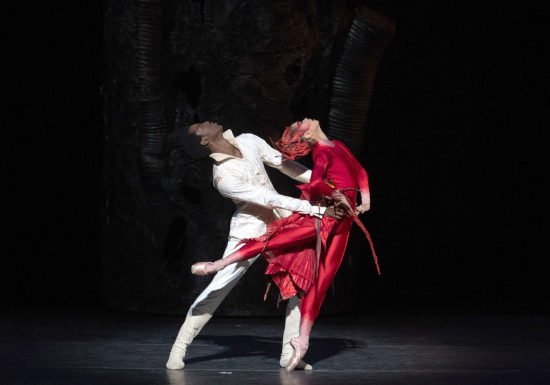
Léa Fleytoux (Firebird) and Calvin Royal III (Ivan) in Alexei Ratmansky’s Firebird. Photo: Nir Arieli.
In the years since the premiere of Ratmansky’s version of the ballet, its multiple sources of inspiration have begun to reveal themselves. The putrid trees (devised by the Russian designer Simon Pastukh) contain some DNA from Ratmansky’s own experience of the Chernobyl disaster and his memories of the “red forests” of radioactive trees that grew for years around the nuclear reactors. Ratmansky began his dancing career in Kyiv, 80 miles from Chernobyl, in the year of the explosion. Radioactive wastelands are embedded in his consciousness. Then there are the green maidens. Why are they so odd and, at the same time, so touching? The combination of absurdism and warmth is a not atypical feature of Ratmansky’s imagination. But here, I realized this time around, he was drawing on another tradition: the menageries of creatures to be found in Bournonville’s ballets, especially A Folk Tale, a ballet that contrasts the underground world of quirky trolls with that of the more stolid humans who live aboveground. As in that ballet, the interactions between the trolls and humans revolve around the effort to find a way to understand each other. Ratmansky spent seven years dancing in Denmark and has been drawing on his Bournonville treasure chest ever since.
The beginning of the ballet suggests yet another inspiration: Petrushka, another ballet by Fokine set to music by Stravinsky for the Ballets Russes. Like the wretched puppet-hero of that ballet, the protagonist of Ratmansky’s Firebird is a pure-hearted soul who finds himself trapped in a bare room, dwarfed by a giant wall. Echoing Petrushka, he feels his way around his prison, seeking a passage out. Here, the doorway is both an escape outward and a portal inward to the villain’s kingdom.
Ratmansky’s ending adds yet another layer of meaning. After the villain is vanquished, with help from the Firebird, dozens of prisoners emerge from trees; they look dazed, as if seeing the light of day for the first time in years. Something similar happens in Fokine’s ballet, but here the feeling is different, less magical, closer to a reality we all know. Years ago I asked Ratmansky about the meaning of his ending, trying to ascertain whether he was commenting on Putin’s Russia, as I suspected. He said that yes, in a way, he was. “Russia is a country that is under the spell of a false idea,” he said then. In his ballet, once the spell is broken, the characters awaken to a new reality. They acquire the ability to see, to understand, to be free. It is an awakening, in every sense. This ending represents a bit of wish fulfillment, a dream for the future.
Today, we see history repeating itself, except that now the spell has been cast here at home, by a different kind of sorcerer, a populist leader who has bewitched his followers through smoke and mirrors. As I watched the figures stumbling from their prisons as if awaking from a bad dream, I wondered whether this is how we will feel the morning after we wake up from our national nightmare.
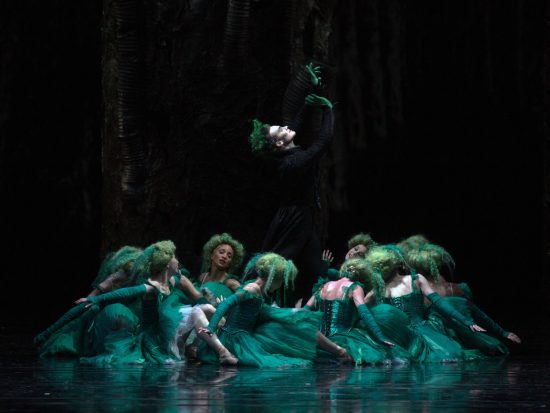
Cory Stearns in Alexei Ratmansky’s Firebird. Photo: Rosalie O’Connor Photography.
Another thing: As in the pas de deux from Flower Festival in Genzano, the private conversation between Firebird’s two main characters revolves around listening, watching, and finding a common language through dance. When the prince in Ratmansky’s Firebird meets his troll-maiden, she does a funny little dance, with hops on point, whirling arms, and taps of the foot. He, in turn, dances for her in phrases made up of serious, lyrical, sweeping steps. The two characters are speaking different languages. But he watches with interest, and learns. Soon he is doing some of her steps, tapping the floor with his toe and whirling his arms. And then, she tries some of his. Until in the end, they mix his vocabulary with hers. It is a beautiful metaphor for a kind of love that respects and celebrates the differences between two beings.
Part of the reason the ballet worked so well this time around was that it was so fantastically well danced. Everything was perfectly clear. I watched two casts, one led by Daniel Camargo as the prince, SunMi Park as the lead maiden, Cory Stearns as the villain, and Catherine Hurlin as the Firebird. The other was danced by Calvin Royal III, Fangqi Li, Duncan Lyle, and Léa Fleytoux. Both casts were phenomenal, though Camargo stood out as a particularly sweet-hearted, attentive Ivan, full of wonder, instantly smitten, encouraging of the maiden’s every move. Both Park and Li found individualized personal accents in the role of the troll-maiden. Park was more dopey, a touch confused; Li pugnacious and prickly. Stearns, who looks like a prince but has always preferred to play villains, crept and slithered his way across the stage, by turns ingratiating and brutal. Lyle, in the same role, was more enthusiastically villainous, with a cackle like the Wicked Witch of the West. I would not want to pick between Hurlin and Fleytoux as the Firebird. Hurlin was all air and nervous energy—as uncontainable as a breeze. But Fleytoux, more petite and with more to prove—she has been fighting her way out of the corps de ballet and was just recently promoted to soloist—danced with an almost feral attack, spiky, wild, absolutely unwilling to submit to any form of control. She was electric.
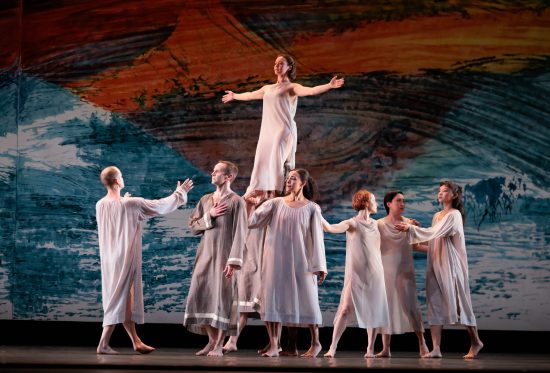
At the Brooklyn Academy of Music in late March, the Mark Morris Dance Group presented two recent works by Morris, Moon and Via Dolorosa. The second was a dance inspired by the Stations of the Cross, set to a work for solo harp on the same theme by Nico Muhly. The harp pieces—spare, quiet, often using descending or ascending scales occasionally interrupted by dissonances and metallic sounds—were in turn inspired by meditations on Via Crucis by the poet and Anglican priest Alice Goodman.
Via Dolorosa, photo by Chris Hardy.
In the past Morris has declared himself an atheist (“I’m not religious—at all,” he told a journalist in 2005), but he is an atheist with an affinity for religious music, particularly of the Baroque period, and religious themes. His 1981 work Gloria, set to Vivaldi’s choral work, is about the basic human struggle for grace and redemption. His 1986 Stabat Mater explores maternal love, sorrow, and loss. He is similarly interested in the figure and story of Socrates, perhaps because, like religion, it revolves around the acceptance of death. For all his cheekiness, Morris has never been afraid to plumb the deeper questions.
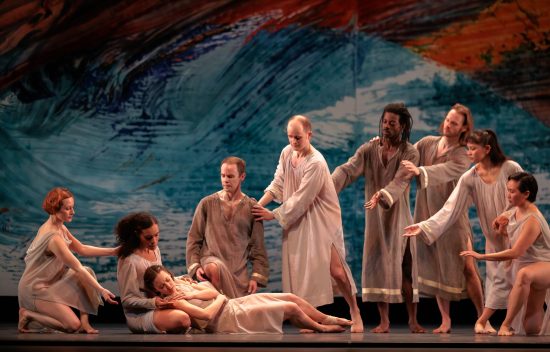
In the new Via Dolorosa he does so with an almost seraphic economy of means. Like the score for solo harp, the dance is almost transparent, using just a handful of motifs, treated with great simplicity and directness, to illuminate the universal story of human suffering. There is no single Christ figure in the dance. All the dancers take on that role at some point; but they are also his tormenters, and Pontius Pilate, and the women of Jerusalem, and the Cross itself, carried, arms splayed, over the shoulder of another dancer.
The dance is both abstract and literal. In the first section, the dancers point downward with their thumbs, as if condemning Christ to death, and mime striking him with whips or stones. (In this section, the figure of Christ is embodied by a woman. Gender is irrelevant.) But at the same time, the pointing and striking gestures become a compositional theme, repeated in different ways, in canons and as a form of call and response. The dancer in the role of Christ runs. Her panic, Christ’s panic, chills the blood. We are reminded that Christ was a person, who, like all of us, was terrified by pain and death. Later, in the fourth tableau (“Jesus Meets His Mother”), we see a dancer spread her legs wide and give birth. She carries the “infant,” an adult-sized dancer, in her arms, caresses his face. He runs around her. These gestures return later, performed by other dancers. In another section, the dancers form a frieze, craning their necks to see Christ as he passes by, carrying the Cross. But the frieze is also a pattern that keeps forming and re-forming itself in slightly different patterns. A scene in which Christ is greeted by the women of Jerusalem is like an Eastern fan dance, graceful and grave.
Via Dolorosa, photo by Chris Hardy.
Every so often something awful happens, in the music and in the dance. A raw, metallic, chaotic cluster of notes, like a pile of dishes crashing to the floor, accompanies the image of Christ falling under the weight of the Cross. When I heard this cacophonous noise, my whole body clenched. The backdrop, luminous brushstrokes of color by Howard Hodgkin, turned the color of blood with Nicole Pearce’s lighting. There was no doubt that beneath the dance’s seraphic exterior something awful was taking place. The image of this human dying on the Cross, arms splayed, head limp, was newly shocking. As his body was carried away, a lifeless arm flopped down. Death is death.
Via Dolorosa is one of the finest pieces Morris has made in years. Its closest kin is his Socrates, from 2010, another work about the process of preparing for death. That piece too had a quietly translucent score, Satie’s song cycle for tenor and piano of the same name. Morris is unique today in his ability to pare down movement and ideas to their most essential, so that they register with particular clarity and resonance. Movement and sound appear to say exactly the same thing. It is a gift.