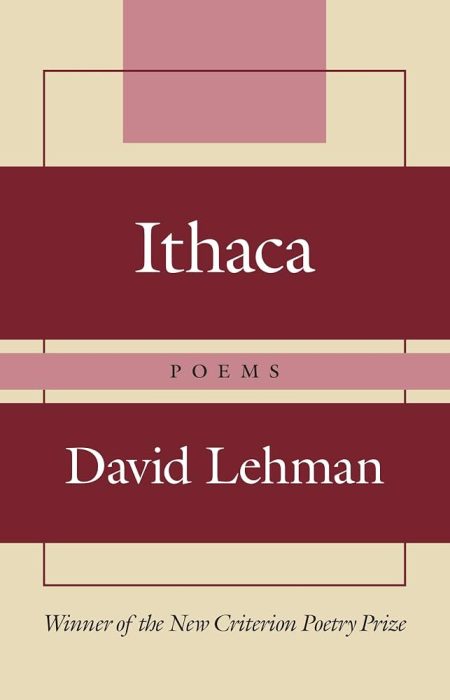
I do not know whether there is any crossover between the poetry audience and the summer blockbuster movie-going crowd; but if there is, David Lehman’s new collection of poems should do very well, with Odysseus and Penelope currently reigning supreme at the box office and Odysseus (usually invoked as Ulysses) the central figure of Lehman’s book, Ithaca.[1] The collection is divided into two sonnet sequences of thirty poems each, “Ithaca” and “Gifts Reserved for Age,” the second title of which comes from a line in T. S. Eliot’s poem, “Little Gidding.” Lehman has the poetic good fortune to live in Ithaca, not the island once ruled by the ever-questing mythic king Odysseus, of course, but the city of some 30,000 souls in upper New York state. (He works in New York City.) His use of the Homeric hero therefore has a geographic basis in his own life, and he is able to draw many fruitful parallels between the ancient world and his own. These lines, with which the fourth sonnet in the sequence “Ithaca” ends, feel like a small-scale reimagining of Odysseus’ homecoming:
. . . The man walks home
from work, a familiar mile of drug stores
and butchers, and then, quickening,
he sees the lights on in the top-story flat.
The reader is easily persuaded that a modern-day Penelope is waiting for him there in that apartment.
Lehman treats the sonnet form with a great deal of latitude. While consistently restricting his sonnets to fourteen lines, he pays less attention to conventional technical elements like meter and rhyme, not to mention the common division of a sonnet into an octave and sestet. The contemporary sonnet, fair to say, needs not reflect the ideals of the age of Petrarch or Shakespeare or (let’s say) Joachim du Bellay, one of whose sonnets provides an epigraph for Ithaca, and would in fact be tiresome if it did. So Lehman writes lines of ten syllables only from time to time, and rhymes equally unpredictably. The opening sonnet, for example, rhymes “oracle” and “miracle” in lines 8 and 9, but otherwise eschews end-rhyme altogether, while employing internal rhyme in line 12 (“on the appointed day, walking the whole way”). By contrast, end-rhyme in the second sonnet is quite prevalent, with the first three lines chiming together (nothing/thing/lovemaking) and the final six following an ABCABC pattern (fork/gets/miss it; cork/regrets/kiss it). That example demonstrates Lehman’s great skill at rhyme. Elsewhere he rhymes “goddess” with “fortress,” “lamentation” with “castration,” “a leer” with “King Lear,” and “rental car” with “film noir,” among many clever instances. (Though not a proper full rhyme, I laughed at his linking “freed” with “Freud” in a line that alludes to The Future of an Illusion (“Freed / of one illusion, would he cling to the gospel of Freud?”) Beyond rhyme there is much clever wordplay, assonance and consonance, and alliteration. A particularly effective example comes in Sonnet 17 in the second sequence:
invisible though able to see the ghosts
of girls in nightgowns gliding across
the bridge, and the barebacked boys on bicycles
with their long scarves flying in the wind.
The sonnets are often allusive in understated ways. I caught some of these allusions—to Proust, to Hart Crane, to The Great Gatsby, to Genesis and Shakespeare (“lust in action”), to Paul Valéry, and so on. Some lines I felt sure were allusions of whose source I was uncertain. Is Nietzsche the “syphilitic madman” who, in the opening lines of Sonnet 11 of “Ithaca,” seems to be broadcasting over the American Forces Network? Did T. S. Eliot really use the phrase “the triumph of bullshit,” as seemingly quoted in Sonnet 4 of “Gifts Reserved for Age”? (I suppose he might have, since Robert Lowell claims, in a sonnet of his own, that he used the expostulation “Balls!” in private conversation.) An allusion to Marianne Moore (“Beyond this fiddle”) comes in a sonnet in which there occurs not only a stunning jeu-de-mots (“lazy days for les idées”), but also these wonderful lines:
These things were important because the memory
of loss was as constant as the loss of memory, and
the whole of his ambition was to lie unclothed in the sun.
And who can argue against the notion that at some ineffable level, as Lehman claims, “The job of the poet was to write poems in praise / of creation,” after which come brief references to Eve, to Aphrodite and Ares, to Botticelli’s Birth of Venus, and to Esther, all crowding in to peek, as it were, over the shoulders of two very modern lovers who, after making love, awake to being argumentative and slightly ashamed of their nakedness. While the overriding themes of Ithaca are belief and happiness, at another level the sixty sonnets also comprise moving embodiments of the oldest theme in the sonnet handbook: love.
I’ll bite. What do you believe in? She ate
a biscuit before answering. In you, of course.
You’re the only thing I believe in. You’re
a beautiful liar, he smiled. But I love thee,
and when I love thee not, chaos is come again.
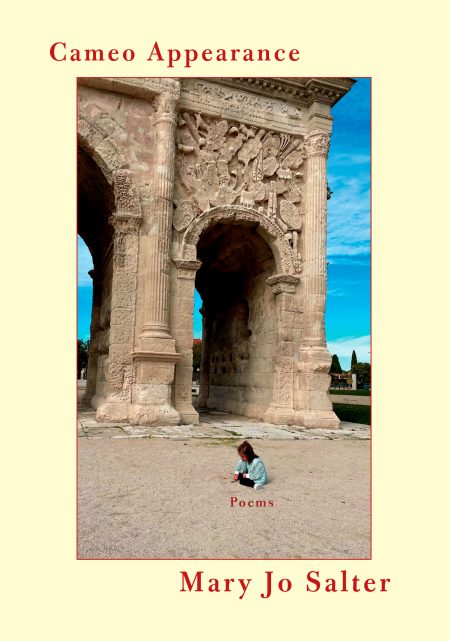
Mary Jo Salter, who is the dedicatee of David Lehman’s new collection, also has a recent book, her first since her collection of Covid-era poems entitled Zoom Rooms (2022). Its title, Cameo Appearance, provides yet another example of how a poet can hear a common phrase and see through to a more ramified meaning, in this case, to the realization that, looked at in one way, most of us only make cameo appearances on the planet.[2] The title poem is in fact about an actual cameo, a ring that the poet inherited from her grandmother, but it is also about memory and how personal experiences come and go and leave little trace. “With people, sublimity never sticks,” as she says in another poem entitled “Full Moon.” As was true also of Zoom Rooms, some of the major poems here are ekphrastic: two about paintings, one each by Gerard David and Piero della Francesca. (There is also a poem about a film, Sylvain Tesson and Vincent Munier’s documentary about the elusive snow leopard, La Panthère des neiges.) The painting by David is his Christ Taking Leave of His Mother at the Metropolitan Museum of Art, a small picture that is half of a diptych. The first section of the poem is devoted to Salter’s trip (presumably from Baltimore) to New York, where she leaves a suitcase at a hotel (“not yet time for check-in”) and takes a subway to what she calls “the pillared temple” and “this vast emporium” that is the Met. (The latter term seems at best dismissive and at worst simply solecistic.) She then describes the painting, though her description has an edge of dubiety to it. She imagines Christ to say, “Catch you later,” to the Virgin—really?—and is detectably ironic in citing unnamed scholarship that sees the painting as different from “the many // variations on this theme / turned out by David // and his workshop and other / ‘mass reproductions’ of their time.” At this point, however, the reason for the poem is revealed: grief. Mary Magdalene’s “dabbing at one eye” with “a diaphanous handkerchief” is what has drawn the poet to the painting. “This is the very essence of grief,” she writes, and the remainder of the poem eschews anything verging on dismissiveness for an emotional avowal: she is “giddy I’ve lived / to pay my dues to sorrow // yet another day.”
“The Flagellation” is a long poem in seven parts occasioned by the poet’s seeing the painting of that name by Piero della Francesca at the Galleria Nazionale delle Marche in Urbino. The first four sections provide background: she notes other paintings by Piero she has seen and gives a detailed look at his portrayal of Christ’s baptism by John the Baptist. In the fourth section we are told, perhaps a little self-consciously, that her attraction to The Flagellation arose from thinking about another ekphrastic poem, Auden’s “Musée des Beaux Arts.” She “went to Urbino,” as she tells us, to determine
if my first impression
held: that this
Italian master anticipated
Auden’s Brueghel,
who would bury the lede
about suffering largely by drowning little
Icarus in detail.
She then describes the painting in the following section, not without a canny allusion to Keats’s “Ode on a Grecian Urn” (“where the arm / of the soon-to-be // beheaded Baptist / is forever raised to bless”), with a seemingly final confession that in the future, the painting, like everything else, “will come tumbling, crumble into dust.” Yet that eschatological certainty is modified in the final section of the poem, which turns to the scene outside of the museum, where young people are celebrating their recent graduation from university. Their “self-possession” puts everything into a more heartfelt and optimistic perspective. “The Flagellation” is a fine addition to the corpus of poems about works of art. Interjections like “But I digress” and the now seemingly pandemic “Regardless” and “Anyway” (“Apollo? Anyway, / a bystander to forgive”) strike one as false notes; but both the details of the description (“grandmothers wobbling in heels unwise / for cobblestones”) and the grander assertions for which art gives permission (the three figures in the foreground of the painting “can’t help but rise (as beauty does) / to become the focal point”) combine to create a convincing whole.
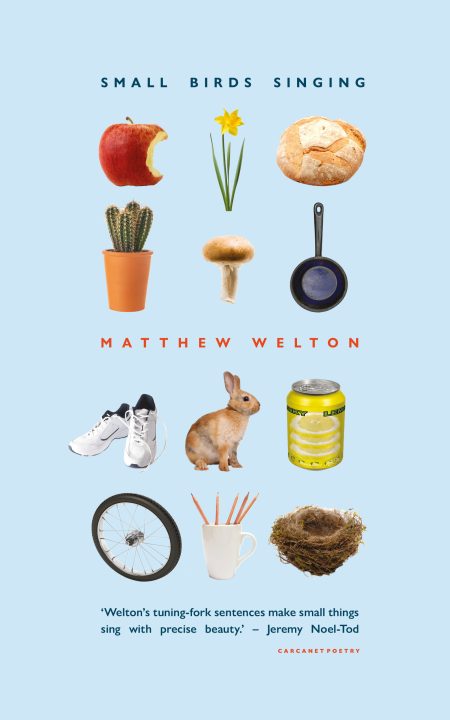
It feels banal to say so, but one of the lessons of Modernism is that poets need to be observant and to know the names of things. Names give us specificity and diversity, and they are the basis for imagery as well as musical variety. Adam and Eve in Book IV of Paradise Lost retire at the end of the day to a bedroom made not simply of flowers, but of laurel, myrtle, acanthus, iris, rose, woodbine (Milton calls it jessamine), violet, crocus, and hyacinth. William Carlos Williams said at the beginning of Spring & All, “If there is an ocean it is here,” and that same book includes poetry’s most celebrated statement of the need for particulars in verse, “The Red Wheelbarrow.” A decade earlier Pound had composed the model Imagist poem, “In a Station of the Metro,” which also focused directly on a real experience but added a second-level comparison strategically similar to Japanese haiku. The individual couplets in Matthew Welton’s collection Small Birds Singing often remind me of both of those canonical twentieth-century poems.[3] Indeed one line—“pigeons on a flat felt roof”—is metrically identical to Pound’s “Petals on a wet, black bough.” Welton’s book is organized as a calendar year with each month containing thirty-some to forty-some two-line poems which alternate between right- and left-justification, creating (as the back-cover copy has it) a kind of zigzag. The couplets are of various kinds. Most simply juxtapose two seemingly unrelated images or statements, such as “a long journey on a short train / my toothpaste tastes like talc” or “the smell of fresh nettles / a page that came loose from a book.” Some collocate things by opposition (“my kitchen timer won’t wind up / the woollen rug unravels”) or parallelism (“flurries of small flowers / a line of geese goes by on foot”). Yet other couplets divagate from the pattern and form single thoughts or perceptions (“coming away from the library clear-out sale / with a–z’s of cities we’ll never visit” or “a bee breaks away from the huddle / and floats at the height of my face”).
The best of the individual couplets in Small Birds Singing are vividly imagistic and sometimes, to use Pound’s word, ideogrammic. Scattered among these focused distiches are other, more philosophical or reflective couplets that are less attractive and sometimes slightly annoying. The first one gives the flavor, as do several others from “September,” the opening month in Welton’s poetic calendar. (These are not contiguous in the text.)
the existence of reality makes space
for the reality of existence
a thing makes its own statement;
the statement is itself a kind of thing
a thing makes itself available;
its availability is itself a kind of thing
a thing is, to some
degree, imprecise
a thing exchanging
itself for its space
Perhaps I am alone in thinking so, but these koan-like statements strike me as being at best like Wittgenstein when he was hungover, at worst like the lucubrations of a teenager convinced of his own innate brilliance. They lack heft and true perspicacity. One has only to compare “every conversation / is necessarily ongoing” (from “April”) with “a papery flower sways in the breeze / a stickleback swims the length of the beck” (from “July”) to feel the difference between the two approaches. The low point of the koan-like couplets is Welton’s use of the word “thinkiness.” It is his invention, and he makes use of it several times—“thinkiness as a dance in which / the gravity is askew,” for example. I deeply wish that he had thought twice. He also employs the word “thinginess.” While that word was not invented by Stephen Colbert, as one might think, but apparently has been in use since the 1890s, it sounds equally unappetising, precisely because of its lack of specificity. Less thinginess and thinkiness and more “[girls] hula-hooping with a bicycle tyre,” please.
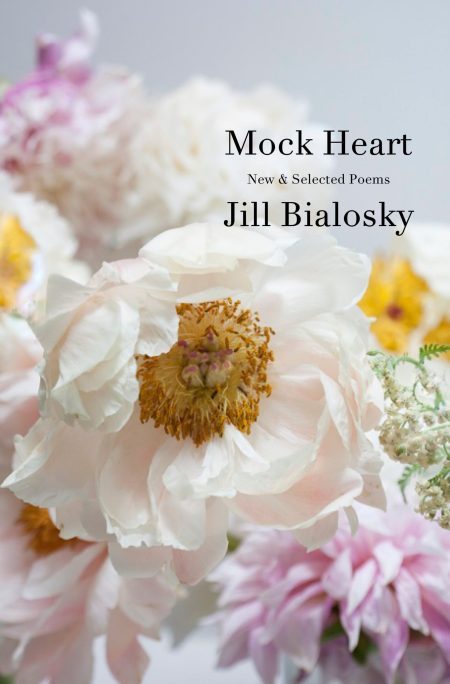
Jill Bialosky has had many successes as a poet and novelist, and especially as a memoirist. She has won prizes and has published in many respected magazines. Despite a plagiarism scandal a number of years ago, she continues to publish and to be an executive editor at a major New York publisher. She has commented publicly on the advantages she feels accrue to a poet, like her, working outside the Academy. Like all of her previous poetry books, Mock Heart: New & Selected Poems is published by Alfred A. Knopf.[4] The editor and book designer Harry Ford accepted her first collection at Knopf, and despite working for W. W. Norton, she has remained on Knopf’s poetry list. This new collection is her first since 2020, and it begins with twenty-three new poems before continuing with generous selections from her five previous books. Her style and her concerns have not changed markedly since The End of Desire (1997), her first book. Parents, family, children, childhood, nature, art: these were and these remain her central subjects. Her poetry is largely written in a relaxed kind of free verse that, while sometimes constricted by a form such as the sonnet (loosely construed), mostly sounds conversational. There is little difference in voice between the opening lines of an old poem like “Stairway to Heaven” (from The End of Desire) and a new poem like “The Sprinkler Game”:
My girlfriend and I snuck out
of our houses at midnight
on a Cleveland winter night
and met at the corner of our block.
*
Sophia stands by the hose, barely
containing herself (I’m watching them from my bedroom window),
& crazily barks until my husband turns on the faucet
& waves the hose like a gleeful baton dance
across the grass.
(Sophia is the family dog.) She does not naturally have recourse to metaphorical language, and some of her older poems seem to me awkward at times through the use of odd turns of phrase. A poem from Intruder (2008) entitled “The Poet Contemplates the Nature of Reality” (a big aspiration!) focuses mainly on that same poet working with a boy on his violin practice. The boy is learning to play “Au Claire de la Lune,” which leads the poet strangely to ask us, her readers: “Do you know it?” (Yes, actually, I do.) The lines contain more than one clumsy locution, including “forcing him to practice his violin, helping him recite his notes”—the verb “recite” seems ill chosen—and “to wrestle his feelings to the listener,” in which “wrestle . . . to” feels inelegant. Somewhat mysteriously, the poem is bracketed by the image of a deer on the side of the road, “frozen, frigid” (surely an unnecessary duplication) at the beginning and alive again at the end, or seemingly so:
. . . The poet contemplates whether a deer can dream.
Rich blood-red berries on a branch, pachysandra in the garden.
A soft warm bed in the leaves.
Graceless phrases and poorly thought-out figurative elements continue to mar Bialosky’s poems, if her selection of new poems in Mock Heart is indicative. That she is capable of the sort of leaps in language that are characteristic of true poetic thinking is proven by the occasional delightful example. Disregarded video games in the bedroom of a boy who has grown up are described as “demobilized,” a brilliant choice. A poem about the state of the poet’s garden in late summer (“Late August Garden”) contains a fine and provocative reflection—“Memory’s a burden. Regret / a scam”—which, if a reader has an ear to catch it, is expertly rhymed in the closing line of the poem: “Isn’t it grand, death’s perverse deceiving sham?” And that execration is picked up again in the title poem, in which the poet alludes to “my crimes, my tawdry oblivion.” Death is indeed another subject to which Bialosky keeps returning. In a partially ekphrastic poem about visiting the Peggy Guggenheim Collection in Venice, Bialosky reacts to seeing some paintings by Pegeen Vail, Guggenheim’s daughter who, as she tells us, committed suicide:
I thought of poverty &
the reason people steal,
& my own naivete and trust
& the nature of humanity,
& poor Pegeen, who made
such lovely paintings
& our poor selves,
artists striving
to make meaning
out of the ash
of our existence . . .
By contrast, many poems are marred by imprecise figurative language and unconvincing tropes. Here is the opening poem in Mock Heart, called “Cleanup”:
They won’t stop. Leaves, slick wet—
curled around shrubs, blanketing
the funeral garden where ravens rest.
Why am I married to longing & lament?
I’d like to slap the face of my unseemly
devotion. Wake up. Don’t be afraid. Wag
your beauty like a dirty dog. Trees shed their pious
costumes. Wind unfurls & as if in ecstasy
more scatter to mock my loyalty. Yes,
cleanup’s messy, imperfect, a disaster.
My limbs hurt. My back aches. One minute
It’s dark, sun hiding behind maple’s bark;
The next light is fixed, like a shattered heart.
It is not clear why this apparent sonnet lacks a fourteenth line. The five poems that follow all contain fourteen lines. But since the poem does not pay heed to any conventions associated with the sonnet form, this complaint may be off the mark. Other aspects of the poem can also be questioned. I’m not sure how one can slap the face of a devotion, for example. I am also not sure what wagging one’s beauty really means; “pious” is a strange word to describe the colored leaves of fall; and “loyalty” feels like the wrong word for what feels like duty or simply work. “Maple’s bark” is awkward; and surely the sun hides behind a bole or trunk, not behind bark. Lastly, an image to accompany the word “fixed” ought surely to be something solid and unbroken, not something “shattered.”
This may seem like nitpicking, but in truth many other poems suffer from the same intransigence where the details of poetic language are at issue. The pathetic fallacy is sometimes resorted to (“Our prized lavender’s lost her sweet / musky scent”) and not far behind it, a kind of Victorian sentimentality (the snow, she writes, is “kissing my lips & face”). The rhyming in a poem called “I Take the Pup on a Walk” is often forced, and words are frequently chosen for their rhyme or half-rhyme and sound awkward. The sequence traverse/nurse/curse also includes “girth” and “reversed”; and the need for rhyme alone produces an unconvincing metaphor in “Memories still alive, in the mind’s sealed purse.” (A sealed purse?) The final couplet of the poem should have caught the eye and blue pencil of any decent editor, as the end-rhymes are inexact and jarring:
You get what you get, a likely besmirch.
Together we sank down in the grass’s berth.
The poem has some formal strengths: it is in couplets, and most of the lines are ten syllables in length. But these characteristics cannot make up for fuzzy metaphors such as “The pink & purple hydrangeas have burst / to mimic the certainty of memory’s rebirth.” Technical flaws stain many other poems. “I Go Back to the Past All the Time” furnishes a further example. The girl in the poem is said to have lost her father “when she was year two.” December “closed the gate & cut the latch.” In that same month, the speaker “woke up & lost my reserve.” In another poem, the clouds are said to be “disseminating.” A poem written in homage to Elizabeth Bishop speaks of a “troubled heart / [that] is not to be mocked or burdened by regret,” when surely the burden of regret is one of the most likely sources of a troubled heart. If Bialosky’s poems, as she tells us in the same poem, “have abandoned [her] // like a flock of lost sheep,” perhaps the shepherdess has some responsibility in the matter.
[1] ITHACA, by David Lehman. Criterion Books. $24.99.
[2] CAMEO APPEARANCE, by Mary Jo Salter. Alfred A. Knopf. $28.00.
[3] SMALL BIRDS SINGING, by Matthew Welton. Carcanet Poetry. £12.99.
[4] MOCK HEART: New & Selected Poems, by Jill Bialosky. Alfred A. Knopf. $36.00.