
The 62nd annual New York Film Festival was held, as always, in early autumn, at precisely that moment when the City is at its most beguiling: sunny, dry, colorful, balmy. Every year, I find myself looking at a packed screening schedule with some reluctance. Do I really want to be spending a good portion of this precious time indoors? But each year the Festival programmers lure me back with an irresistible bounty of films from pedigreed directors, films that have caused sensations at Cannes and other previous festivals, films with captivating premises. And Alice Tully Hall, with its gigantic screen and superb sound, is the best movie venue in town. The post-screening Q&As with the artists can be a bit anodyne (“What was it like to work with Angelina Jolie?” “Wonderful!”), but every once in a while there’s a striking insight that unlocks a film. And so, every year I head back into the dark.
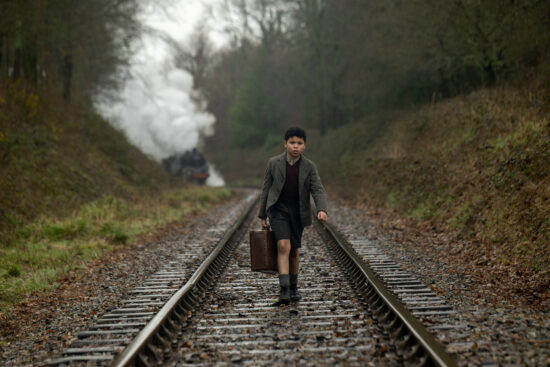
Elliott Heffernan in “Blitz,” now streaming on Apple TV+. Courtesy Apple TV+.
Almost every film I saw at last fall’s Festival opened commercially in the ensuing months. One of the first to do so was Blitz, an epic depiction of the German bombardment of London during the Second World War, as seen through the eyes of a young boy. Director Steve McQueen (12 Years a Slave) vividly re-creates the terror of that time. This is a much more violent, realistic depiction of the Blitz than usual; there are no Minivers gallantly sipping tea, knitting, and reading the newspaper in their underground bunker. The film focuses on nine-year-old George (Elliott Heffernan), one of the many children sent to the countryside to escape the bombs. His single mother Rita (Saoirse Ronan) works in a factory and, while reluctant, knows that George will be safer out of London. George does not want to leave and lashes out at his mother at the train station. He later jumps off the train and begins a daunting odyssey home, through the ruins and ravages of wartime London.
McQueen, who also wrote the film, introduces a fascinating layer to the usual British wartime milieu: George is mixed race. His father, now out of the picture, was Black. This complicates his treatment by the various people he meets on his journey, whether benevolent or predatory. McQueen depicts the significant presence of a multicultural community in 1940s Britain, and this is the film’s strongest component. Racial tensions in the many makeshift shelters show that a country united against a supremely racist enemy was not always on the same page internally. McQueen is aided by superb designers and technicians in his reconstruction of this historical moment.

Saoirse Ronan in “Blitz,” now streaming on Apple TV+. Courtesy Apple TV+.
In addition to complicating what is usually depicted as a monolithic social context, McQueen also uses avant-garde techniques to undermine the usual heroic World War II narratives. The episodic story is made up of discrete segments that often begin and end without clear markers. Several climactic moments that would typically be centered in a war movie are skirted or even omitted. McQueen also employs stylistic acting and photography, presumably to avoid the trappings of naturalism. Ronan (typically superb) and many of the adults give fully dimensional performances, but most of the children seem like the cutesy young actors in old Hollywood movies, so much so that there must have been intention in this choice. This proves problematic in the case of Heffernan who is onscreen for most of the film. We struggle to connect to George, as the actor gives us little in the way of realistic childhood behavior. His situation is enthralling, but the performance leaves us somewhat outside of the story. In the least successful section of the film, George falls in with a group of Dickensian thieves, and McQueen raises the level of grotesquerie—in both acting and filmic style—to bizarre proportions. Nevertheless, the strong components of the film overcome its problems, and the final moments are gratifyingly emotional.
Much attention was lavished on Pedro Almodóvar’s first English-language film, The Room Next Door. The Spanish director, a legend in his own lifetime, has resisted countless overtures from Hollywood, afraid that his limited English would compromise the detailed attention to tone that characterizes his films. But his language skills have apparently improved in recent years, and he finally felt ready to tackle an English-language film—but on his own, non-Hollywood terms. The result is not in the ranks of his finest work—a very high bar. But thanks to outstanding central performances from Tilda Swinton and Julianne Moore, it’s a powerful, captivating film. Swinton plays Martha, a woman dying of cancer, who asks Ingrid (Moore), an old friend, to help her take her own life. She wants someone in both the literal and metaphorical “room next door” as she undergoes this passage.

TILDA SWINTON as Martha, JULIANNE MOORE as Ingrid in ‘The Room Next Door’ Image: Iglesias Más. © El Deseo. Courtesy of Sony Pictures Classics.
Almodóvar’s concern about tone was well founded. Many have noted that the film’s dialogue feels stilted, as if the characters are reciting rather than conversing. I don’t think this is the result of a language barrier, though. For me, the dialogue is of a piece with the director’s overall, and characteristic, stylization. His depiction of New York and its environs is intensely colorful and elegant, to a wonderful but artificial degree. Alice Tully Hall itself makes a cameo appearance, looking stunning. It’s fascinating to see the City through Almodóvar’s eyes: it’s preternaturally quiet.
The starting point of The Room Next Door is grief—but Almodóvar’s approach is dry-eyed. He is more interested in the relationship between these two women and the extrapolation of that relationship to society in general. In its depiction of an ill woman and her caregiver, the movie explicitly references Ingmar Bergman’s Persona and, as in that masterpiece, the two women undergo a transference, literalized by shots of their faces juxtaposed and sometimes merging. Ingrid has an unnatural fear of death, but she absorbs Martha’s strength by the end of the film. Martha absorbs Ingrid’s empathy and comes to terms with the fact that her death has a ripple effect. Despite the sadness at the center of the story, it’s an optimistic film, an ode to the necessity of connection, both on the individual and the macro-political level. The Q&A after the screening I attended, featuring Almodóvar, Swinton and Moore, was disrupted by pro-Palestinian protesters. When the audience booed them, the director and actors rose from their seats and asked for calm, inviting the protesters to say their piece, which they did. After this disruption, Swinton praised the protesters for their courage in speaking their truth, pointing out that the film is about the necessity of witnessing our fellow humans: “We are in the room next door to Syria, to Beirut, to Gaza, to Jerusalem,” she said. Almodóvar regretted that a movie will not be able to solve the world’s problems—and he’s right. Film art can’t directly fix anything, but it can create and promote empathy—and that’s the required starting point for the necessary work of global healing.

JULIANNE MOORE as Ingrid, TILDA SWINTON as Martha in ‘The Room Next Door’ Image: Eduard “Edu” Grau. © El Deseo. Courtesy of Sony Pictures Classics.
Empathy was at the center of Mike Leigh’s Hard Truths, a new triumph for this chronicler of the extremes of the human condition within quotidian circumstances. Reuniting with the splendid actress Marianne Jean-Baptiste for the first time since 1996’s Secrets & Lies, Leigh turns his camera on a middle-class family in London who are held captive by the oversized rage of wife and mother Pansy. One of those people who wakes up with ferocity and who spends her day screaming at checkout clerks and waiters, Pansy reserves her most lashing fury for her family. Leigh is unrelenting in showing how depression and pain manifest in the body; Pansy is literally exhausted by her constant anger. Leigh isn’t afraid of making that anger occasionally funny—sometimes the only response to behavior that extreme is laughter. But Leigh also forces you to find empathy with Pansy. The sheer fact of his camera’s constant close-up on Jean-Baptiste’s face forces the issue. The film is a profound exercise in connection despite the odds.

Kieran Culkin and Jesse Eisenberg in A REAL PAIN. Photo courtesy of Searchlight Pictures, © 2024 Searchlight Pictures. All rights reserved.
Depression is also the unspoken heart of A Real Pain, Jesse Eisenberg’s beautiful, funny, wise new film which he directed and wrote and in which he stars opposite a perfectly cast Kieran Culkin. As cousins who are fulfilling a dying wish of their Holocaust-surviving grandmother by traveling to her childhood home in Poland, the two actors play variations on their usual roles: Eisenberg the neurotic, warily intelligent stammerer and Culkin the mouthy, tactless sprite (most familiar from his award-winning work in Succession). But both are so good at what they do, and the film is so likeable, that we forgive the on-the-nose casting. Culkin in particular is magnificent at showing the self-loathing underneath the sarcastic, profane jokester. His Benji is profoundly depressed—by the loss of his beloved grandmother, by his inability to find adult stability—and the film sensitively connects those struggles with the larger legacy of American Jews still grappling with the catastrophe in Europe. Culkin dominates the film, but Eisenberg gets the best scene: a monologue at a restaurant table, filmed in a long single zoom-in, as he tries to explain his complicated relationship with Benji to fellow members of their tour group. He loves him and hates him; he envies and pities him; he’s scared of him and wants to protect him. All of this is manifestly clear in the characters’ dynamic throughout this carefully built and acted film.
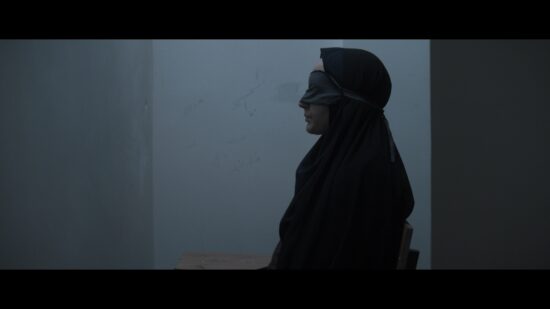
THE SEED OF THE SACRED FIG. Courtesy of NEON
The Iranian director Mohammad Rasoulof is directly living the impact of global unrest. His new film, The Seed of the Sacred Fig, depicts the protests that roiled Iran in 2022 after the murder of Mahsa Amini by the country’s religious police after she had been arrested for incorrectly wearing her hijab. Rasoulof, who was already under government suspicion for his outspokenness, had to make the film under severely restricted conditions. Due to his previous activities, he was convicted of crimes against the state earlier in the year and sentenced to flogging and imprisonment. He wisely fled the country and now lives in exile. His presence at the New York Film Festival was electric—a testament to the resilience of art in the face of religious repression.
The movie is actually an intimate family drama, focusing on a government functionary, Iman (Missagh Zareh), and his wife Najmeh (Soheila Golestani) and teenage daughters Rezvan (Mahsa Rostami) and Sana (Setareh Maleki). As protests break out in Tehran, the girls express solidarity with the women on the streets and turn to social media to bypass the lies told by the state-controlled media. Iman, partly out of a sense of patriarchal duty and partly out of fear for his job, supports the government, as does the fearful Najmeh, at least initially. In one of the movie’s first scenes, Iman is given a gun so that he can protect himself and his family. Chekhov’s law ensues, and the fate of the gun leads to suspicions that tear the family apart.
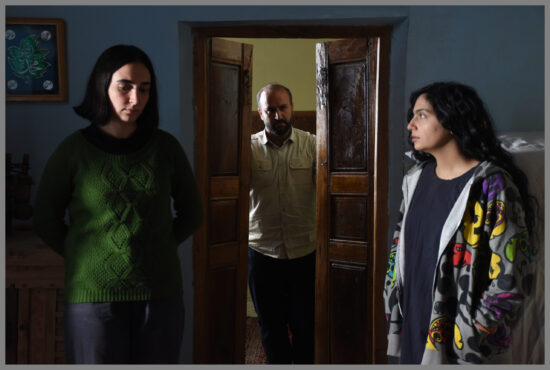
THE SEED OF THE SACRED FIG. Courtesy of NEON
Rasoulof’s coup is to turn this closely observed, superbly acted and filmed depiction of a family into a microcosm of contemporary Iran. Iman, the father/state thinks he is being loving and protecting, that he is nurturing his family’s/citizens’ relationship with God. In reality, he is corrupt and ultimately paranoid, resorting to violence to control his children and even his wife who has always defended him. Like the country around them, the family devolves into brutal struggle. A climactic chase is unbearably tense. Rasoulof intercuts footage of the actual 2022 protests, most of it from cellphones, into his film, and this choice ennobles the work. As so often in modern Iranian films, Tehran comes off as surprisingly advanced, not at all a medieval backwater. The family shops, dines, commutes, watches television, scrolls on their phones. This makes the events of the film frighteningly palpable. The unthinkable theocratic repression in Iran is made unnervingly thinkable when seen in such a recognizable context.
Almost everything I saw at the Festival was worthwhile, even when the films had serious flaws. The Chilean director Pablo Larraín completed a trilogy of films on celebrated women in the media spotlight, following 2016’s Jackie (on Jackie Kennedy) and 2021’s Spencer (on Princess Diana) with his new Maria, starring Angelina Jolie as Maria Callas. Like the other two films, Maria confines itself to a few days in the life of its protagonist, with occasional flashbacks. And like the previous films, Maria surrounds a superb central performance with a diffuse, protracted narrative that is more meditation than film. Jolie is uncanny, perfectly capturing Callas’ unusual diction when speaking, as well as the seething anger underneath her equanimity. Her lip synching to Callas’ voice during the singing scenes is the most convincing I’ve ever seen in a film about opera. The re-creations of the singer’s legendary stage triumphs are thrillingly accurate. The film is catnip for Callas fanatics like me, but those who don’t know the lore might find the film opaque. Important characters like her first husband, Giovanni Battista Meneghini, are unidentified.
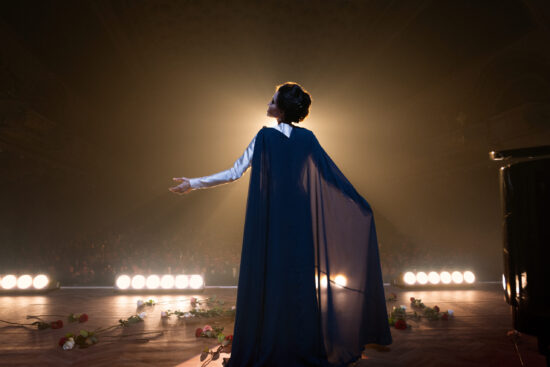
Angelina Jolie as Maria Callas in Maria. Cr. Pablo Larraín/Netflix © 2024.
Music is also central to Emilia Pérez, a thrilling gonzo stunt from director Jacques Audiard. Picture a Mexican drug cartel boss who wants to exit his criminal life and transition into a woman. Picture the sexy lawyer who helps him achieve this goal and then enables a charitable foundation that helps the victims of the cartel’s violence. Picture a French director, known for naturalistic depictions of working-class life (A Prophet, Rust and Bone) tackling this Spanish-language project. Oh—and it’s a musical. A full-fledged, song-and-dance musical. Emilia Pérez has divided critics and audiences (I loved it but distrust it). All agree, however, on the superb performances at the film’s center: Karla Sofía Gascón as the criminal who becomes the titular Emilia, and Zoe Saldaña, in the best work of her career, as the lawyer Rita.
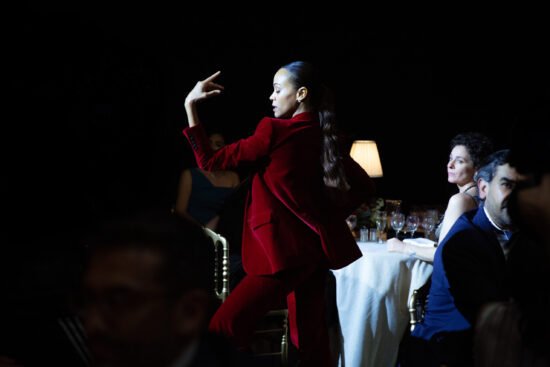
Zoe Saldana as Rita Moro Castro in Emilia Perez. Cr. Shanna Besson/Pathé © 2024.
Naomi Watts and a massive, charismatic Great Dane star in The Friend from directors Scott McGehee and David Siegel, another film about grief. Slight and not without charm, the film is too literary, with precious voice-over narration and characters who feel trapped in a Salinger story, lacking cinematic life. The dog is marvelous, though, and aficionados of a certain kind of New York City literary milieu will find the film comforting. Paul Schrader’s Oh, Canada was the only film I saw at last fall’s Festival that truly disappointed. A reunion between American Gigolo collaborators Schrader and Richard Gere, the film focuses on Leo Fife, a dying film director who, decades earlier, had fled to Canada to escape the Vietnam draft. Flashbacks to that era (with Jacob Elordi as the young Fife) alternate with the shooting of a documentary on Fife’s life, attended by his wife Emma (Uma Thurman). Thanks to an unreliable narrator structure, the film lacks stakes; it’s hard to invest when you’re not sure what’s really happening. And the big reveal at the end was obvious in the first ten minutes. The repetitive screenplay, by Schrader based on a novel by Russell Banks, grows wearisome, and the dark, cramped visual approach, which worked superbly in Schrader’s First Reformed, feels stifling here.

All We Imagine as Light. Courtesy of Sideshow and Janus Films.
All We Imagine as Light was, shockingly, the first Indian film to compete in the main competition at Cannes since 1994. Given that India produces more films each year than any other country, the absence was astounding. Directed by Payal Kapadia, whose first narrative feature this is, the film takes place in contemporary Mumbai, a polyglot metropolis. The film opens with a montage of overheard conversations and internal monologues, all in just a few of the dozens of languages that fill the Indian subcontinent. All We Imagine as Light eventually narrows its focus to three women employed at a hospital: two nurses and a food service worker, all at different stages of life. Young Anu (Divya Prabha) is optimistic and lighthearted, engaged in a secret courtship with a polite young Muslim man, something her Hindu family would never countenance. Parvaty (Chhaya Kadam) is middle-aged, stoical, and fighting eviction from her apartment. Prabha (Kani Kusruti), the central character, is married, but her husband has emigrated to Germany, and the couple is essentially estranged, although they have not formally acknowledged this. A shy doctor makes a few overtures to her, but she can’t find the nerve to respond.
All We Imagine as Light is many things: a fascinating and deep portrait of life in modern Mumbai; a hushed, intimate character study of three women; and a paean to the difficulty of imagining another way of life when one lacks the means or will to achieve it. Prabha is in a legitimate relationship, but it is characterized by absence and loneliness. Anu is in a forbidden relationship, but it is romantic and gentle. By the end of the film, the two women have changed each other, much as in The Room Next Door. Anu helps Prabha open up, and Prabha helps Anu look at life with maturity. These nuances are realized in the exquisite performances, most particularly that of Kusruti, who has a magnificent face for film. She can look ravishingly beautiful in some shots and haggard and despairing in others. She holds the many facets of the character in her visage, as well as the enigmas. She is both sad and complacent, hopeful and resigned.

All We Imagine as Light. Courtesy of Sideshow and Janus Films.
In the last third of All We Imagine as Light, Anu and Prabha, who originally hail from the southern province of Kerala, leave Mumbai and visit Parvaty’s hometown, an oceanside village in Ratnagiri. Here the film takes some brief detours into surrealism, such as a scene where Prabha saves a man from drowning and, in a dreamlike sequence, becomes his wife. Throughout, Kapadia keeps a firm grip on tone and character, and the film, which took the second-place Grand Prix at Cannes, is a small miracle of insight and delicate beauty. Most of the movie takes place at night, often in the rain, and this fact creates a sense of haunted, almost existential weight which suffuses the film’s muted narrative.
Brady Corbet’s The Brutalist is the first American film in over 60 years to be shot in VistaVision. This high-resolution film format was used for some of the greatest and most magnificently visual movies ever made: Vertigo, The Searchers, North by Northwest, not to mention that granddaddy of film epics, The Ten Commandments. Corbet, who directed and wrote (with his partner, Mona Fastvold) this new film, has aimed for that level of achievement, and the attempt is exciting and admirable, if not always successful. The Brutalist is huge in every way. It’s an epic vision of 1940s and 1950s America that encompasses the Holocaust, the revolution in postwar architecture, and the folly of godlike ambition. The film lasts three hours and thirty-five minutes and is performed with an overture and intermission. Few theaters today can project a VistaVision print, so most theaters will show 35-millimeter reductions, although the New York Film Festival held several screenings of 70-millimeter prints, one of which I was happy to see. From the film’s titles, horizontally scrolled in a period-appropriate font, to its bravura opening sequence which ends with a group of immigrants on a boat joyously greeting an upside-down Statue of Liberty (a fractured homage to The Godfather, Part II), I knew I was in for a movie-movie, a big swing.
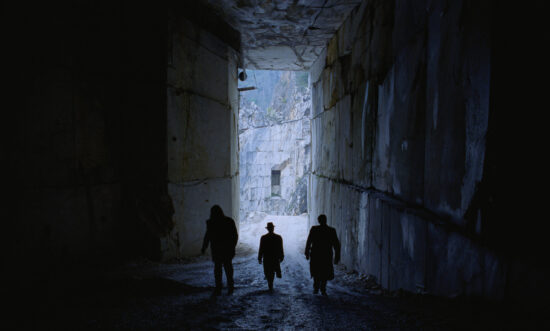
(L-R) n/a, Adrien Brody, Guy Pearce. The Brutalist. Courtesy of A24
The Brutalist follows László Tóth, a Hungarian Holocaust survivor played by Adrien Brody, who, after the war, makes his way to Philadelphia, where he initially stays with his relative Attila (Alessandro Nivola). Tóth’s wife Erzsébet (Felicity Jones) has survived but is trapped in Europe. He works odd jobs until it becomes known that he was a major architect in his native Budapest. Tóth is eventually engaged by the wealthy Harrison Lee Van Buren (Guy Pearce, in a sensationally stylized turn) to build a monument to his late mother. Van Buren helps expedite Erzsébet’s immigration to America, and the second half of the film dives into deep explorations of the complex relationship between assimilated American Jews, European Jews, and the new generation of Israelis, all within the broader context of American anti-Semitism. Corbet ties these sociological issues into an aesthetic analysis of Brutalist architecture, which paradoxically combined a minimalist approach to decoration with a maximalist approach to scale. The film makes clear that Brutalist buildings are things in and of themselves, not vessels of meaning. This hermeneutics holds for most of the film’s running time: Tóth seems to divorce his experience from his designs. We could be watching a modern gloss on Ayn Rand’s The Fountainhead, or Ibsen’s The Master Builder: a “great man” narrative which foregrounds the obstacles faced by the genius architect who wants to build something that touches the heavens.
I thought of Rand and Ibsen throughout The Brutalist, and also Warren Beatty’s Reds and Paul Thomas Anderson’s There Will Be Blood. These are all formidable antecedents (apart perhaps from the odious Rand), and Corbet is clearly aiming to live in their company. He doesn’t quite achieve this goal, mainly because much of the philosophizing in the film feels undercooked, and because plot turns in the second half feel deliberate and not inevitable. A powerful epilogue to the film provides an explanation for Tóth’s aesthetics, reversing the previous interpretation of Brutalism and positing that it actually arose from the crucibles of Dachau and Buchenwald. This delayed revelation is a twist that makes you rethink everything that came before, but also robs much of the film’s running time of resonance. Nevertheless, the film has the feel of a major achievement, even if it’s not quite that. On the credit side are superb performances, not just from Pearce, but also Jones, who takes a big bite (heavy accent + disability) and sticks the landing. Best of all is Brody in the performance of the year. In his first few minutes on screen, he weeps with a sadness that seems to contain the entire cataclysm of the Holocaust. Over the next few hours he never missteps, no matter how big or curious the demands of the script.
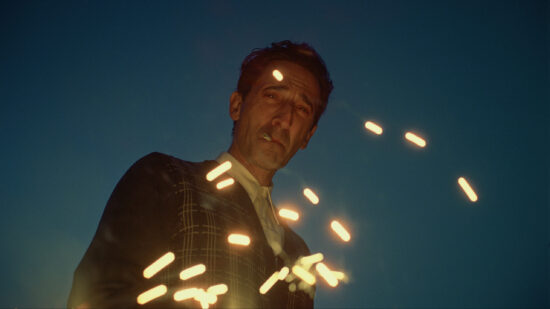
Adrien Brody in The Brutalist. Courtesy of A24
I can’t end this account without a few words about Francis Ford Coppola’s Megalopolis, which screened as a Festival auxiliary event. The film was the culmination of decades of planning by the great director, who in his heyday made three of the greatest films of all time: the first two Godfather movies and Apocalypse Now. Coppola hasn’t made a film even close to those achievements in the decades since. Megalopolis was self-funded—the director sold his vineyards to finance the film—and it’s the most avant-garde film he’s ever made, as well as one of the most visually ambitious. The narrative, such as it is, follows a determined architect (yes, again) named Cesar Catilina (Adam Driver) who wants to remake the city of New Rome, a fictitious stand-in for New York City in the context of a modern Roman Empire. He faces opposition from the status quo Mayor Cicero (Giancarlo Esposito), while simultaneously dealing with the ultra-rich Crassus (Jon Voight) and the populist provocateur Clodio (Shia LaBeouf, occasionally in drag). Cesar also woos the mayor’s rebellious daughter Julia (Nathalie Emmanuel). And there’s a tabloid journalist named “Wow Platinum” (no, I’m not kidding) played by Aubrey Plaza.
Megalopolis is, in many ways, indescribable. Deliberately so. It revels in incoherence, in discontinuity. The plot is almost impossible to hold on to. A day after seeing it, I would have had a hard time explaining what happened. It is, without a doubt, the strangest big-budget, mainstream-released movie I can recall seeing. It was an inevitable box office catastrophe. I also love the fact that it exists and would not have missed it for the world. It is eminently watchable; I was never bored, and huge chunks of the film have stayed with me months later. Coppola has a lot on his mind, specifically empires (Roman and American) and their disastrous ends. The filmic references to this political context are fast and furious: Stanley Kubrick (especially Spartacus), Fritz Lang’s Metropolis, Chaplin’s The Great Dictator (especially Cesar’s final, overly earnest speech), Abel Gance’s Napoléon (especially in a scene with a three-part division of the screen), William Wyler’s Ben-Hur. Coppola critiques populism: “Make Rome Great Again” signs are seen at protests. But his ideas of gender and sex are mired in the 1970s. There are old, almost Catholic ideas about virginity. Is this just Coppola on the therapist’s couch? The politics of the film don’t let you decide; in fact, this is a post-politics film.
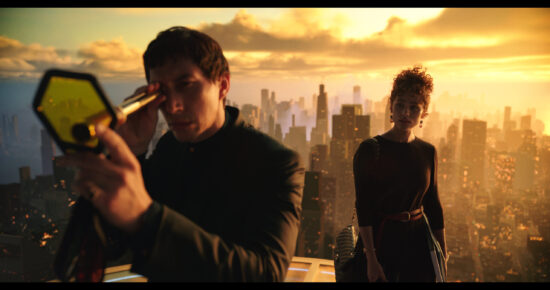
Adam Driver as Cesar Catilina and Natalie Emmanuel as Julia Cicero in MEGALOPOLIS. Photo courtesy of Lionsgate.
The acting is all over the place. Driver is game—even delivering Hamlet’s entire “To be, or not to be” speech at one point. His performance is big, angsty, and confident. Conversely, Emmanuel is in over her head. At a few points, Dustin Hoffman(!) shows up in a small role. I had to check IMDB to make sure I wasn’t dreaming. The visuals of the film are more consistent, and often breathtaking. This is not just a matter of hiring good designers. Megalopolis clearly results from a strong directorial hand corralling all the visual inspiration, not least an image of a ghostly hand closing over a moon that I will never forget.
At my screening, the audience began to laugh when Julia quoted Marcus Aurelius halfway through the film. This seemed to break a barrier, and the audience suddenly felt they had permission to regard the whole film as camp. Much laughter ensued. At the same time, there was warm applause at the end of the film, a sort of admiration for Coppola’s daring vision. Its very existence is, in a way, Coppola’s point or, better stated, his provocation: the film is not, in any conventional sense of the words, good or successful. But it exists and demands attention. It can’t be dismissed. It forces you to ask what “good” actually is. Is Megalopolis in on its own joke? That’s hard to tell. Is it the work of a relentlessly avant-garde mind, or of senility? If Jean-Luc Godard had directed the film in his final days, would we consider it his ultimate masterpiece? Or a misfire? I don’t think we’ll have an answer, nor will we truly understand what Megalopolis is, for at least a few decades. History will have to judge.

Natalie Emmanuel as Julia Cicero and Adam Driver as Cesar Catilina in MEGALOPOLIS. Photo courtesy of Lionsgate.